Curious what a bottomless portafilter actually is and why so many baristas use one? This special portafilter shows you exactly how your espresso flows and helps you improve your technique.
In this blog, we explain what a bottomless portafilter is, what the benefits are, and how to use one without covering your whole kitchen counter in coffee splatters.
What is a bottomless portafilter?
A bottomless portafilter is a portafilter without a bottom. So when you look underneath it while pulling a shot, you're looking straight at the filter basket. That's where the espresso comes out of the machine.
Having a direct view of the extraction matters, because you can see exactly how evenly the coffee flows and spot any mistakes straight away. On top of that, a bottomless portafilter has no spout for coffee residue to collect in, so it's easier to keep clean.
Why use a bottomless portafilter?
A good extraction means a tasty, balanced espresso. When an espresso is out of balance, you taste it, but you can actually see it during brewing too. A bottomless portafilter helps by laying the extraction bare.
Because a bottomless portafilter has no bottom, you're looking directly at the underside of the filter basket. If you've tamped unevenly, you'll see that the espresso doesn't flow evenly out of the basket.
If there are clumps in your ground coffee, the water can't flow evenly through it either. It takes the path of least resistance and creates little tunnels in the coffee, which is called channeling. That means not all the aromas get extracted, and you end up with an unbalanced espresso.
With a bottomless portafilter, it's much easier to see what's going on when your extraction isn't right, so you can fix it. With a portafilter that has a bottom and spouts, you can't see any of this.
How to use a bottomless portafilter
Basically, you use a bottomless portafilter exactly the same way as a regular portafilter.
- Click the included filter basket into your bottomless portafilter.
- Use a dosing ring to get all the coffee neatly into the basket.
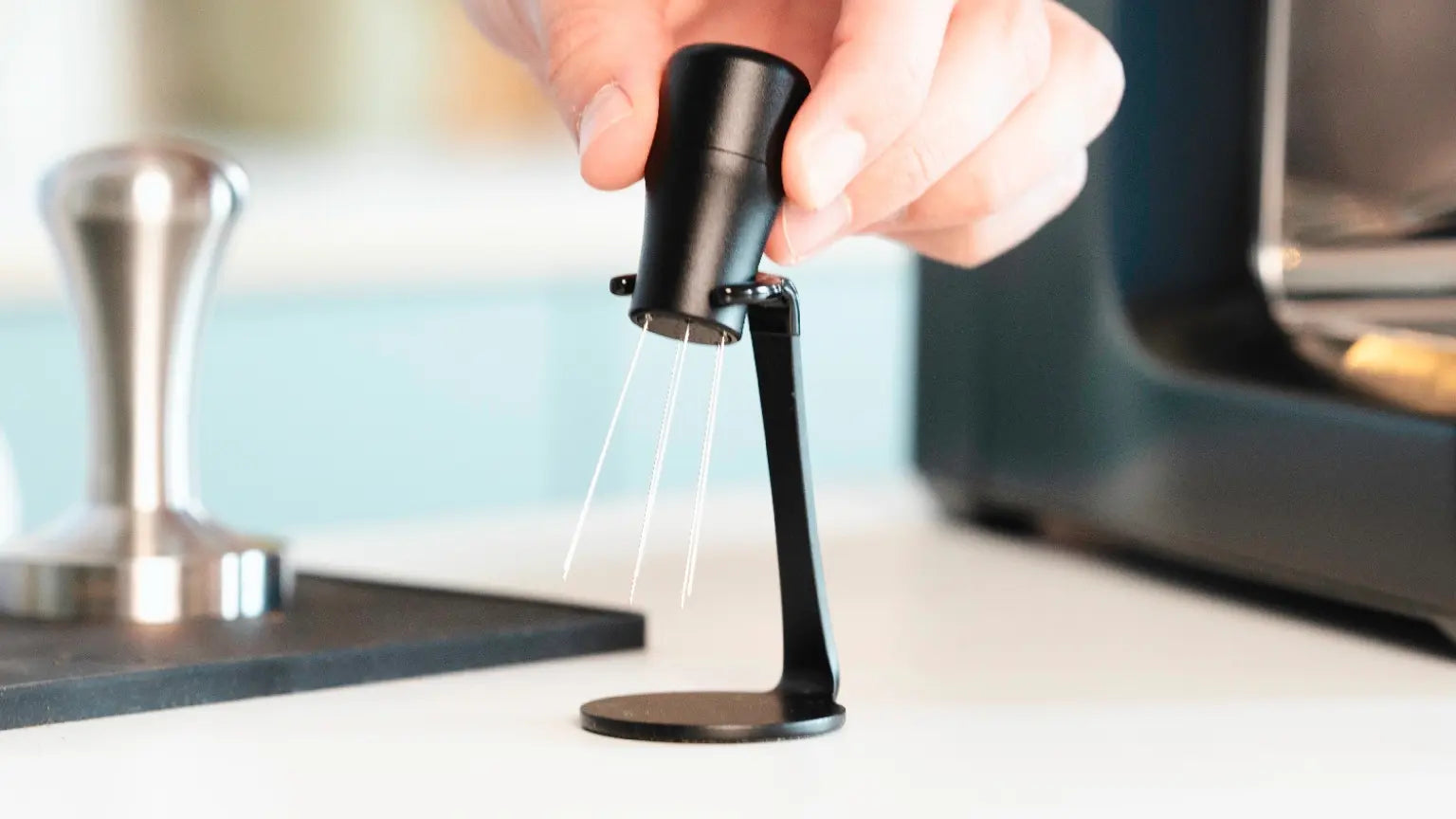
- Break up any clumps with a WDT tool and use a coffee distributor for a level surface.
- Place your bottomless portafilter on a tamping mat to protect your worktop.
- Tamp the coffee level by applying firm pressure once.
- Lock the bottomless portafilter into the group head.
- Keep in mind that the espresso may splatter when you start the machine.
- Watch the extraction closely.
- If needed, adjust the grind size or the amount of coffee for your next espresso.
Tips & tricks for your bottomless portafilter
- Stir the ground coffee before you pull your shot. Breaking up the clumps lets the water flow evenly through the coffee and improves your extraction.
- Use a coffee distributor to get a level top layer that you can then tamp consistently.
- Use a tamping mat so you can tamp steadily. The water flows through more evenly and there's less splattering.
- Is your espresso still splattering with the bottomless portafilter? Grind a little finer, so the water gets more resistance and the espresso flows out of the basket in a steady stream.
- Use freshly roasted beans. Only then can you really start working on a good extraction. Check out our specialty coffee beans.
Bottomless portafilter: common problems and solutions
My coffee splatters everywhere
This is a common problem and often the starting point for many home baristas using a bottomless portafilter for the first time. Apart from a messy kitchen being annoying, it's actually good news: it means there's still something to gain!
Splattering is often a sign that the water is passing through the coffee puck both unevenly and too hard. If that's the problem, you really need to go back to the basics. These tips will help you on your way:
Are your ratios right?
A good starting point for a double espresso is 18 grams in and 36 grams out, in 25 to 30 seconds.
Have you distributed and tamped the coffee?
If the coffee isn't evenly distributed, the water forms "channels" through your coffee where a lot of pressure builds up and the espresso sprays out. This is really important. You can use a coffee distributor, but tapping the portafilter with the palm of your hand is a good alternative when you're just starting out. After that, good tamping is of course key. Tamp with reasonable pressure and keep it level, so the water can work its way evenly through the puck.
How old are your beans?
Freshly roasted beans (roasted no more than 2 months ago) generally flow more slowly and give a better extraction and taste.
How are your beans ground?
To stop the water from running through the puck too quickly, you can grind your beans a little finer.
My shot runs too fast (or too slow)
This is another common problem. If you distribute and tamp your coffee well, you can avoid a lot of the splattering above. The shot then seems to run nicely, but it does so far too quickly (let's say 36 grams in 15 seconds). This often results in a weak, sour espresso.
So if your coffee tastes a bit too sour, your extraction may well be running too fast. The solution is to grind finer, so you get a better extraction time.
If your extraction takes too long, the solution is to grind a little coarser instead.
I have channeling on one side of my portafilter
This problem is hard to spot, but it can happen that the espresso flows out nicely on one side of the portafilter but not on the other.
Filming your shot can help you spot this, since it's less obvious than the splattering of a bad extraction. You'll see bubbles and foam on one side of the portafilter.
This can happen when your puck comes loose from the wall of your filter basket, for example because you tap against it with your tamper after tamping.
Tamp once and keep it level to prevent channeling as much as possible. That might just be the detail that makes your espresso better.
Cleaning and maintaining your bottomless portafilter
A bottomless portafilter needs very little cleaning, because there's no bottom for coffee residue to collect in. In a portafilter with a bottom and spouts, coffee residue often stays behind.
If you take the filter basket out of a regular portafilter after a while, you'll see it's completely black from coffee residue. To get it clean again, you need to soak the stainless steel parts. You can read exactly how to do that for a regular portafilter on the portafilter product pages.
A bottomless portafilter is easy to clean: just rinse it with water. You can also use a brown barista cloth if you're making several espressos in a row. The handles of the black and wooden bottomless portafilters should not be left soaking in water. And don't put your bottomless portafilter in the dishwasher either, it can't handle that.